
The Future-Proof Workforce: How Upskilling Empowers Employees and Businesses Alike
Reskill, Refuel, Recharge



Last week we talked about how traditional higher education is in turmoil. This week we’re talking about the importance of upskilling your workforce—an issue near to both of our hearts. If this feels like a sales pitch, it’s because it is. In a world where fewer people go to college, or see less value in a traditional degree program, workforce L&D programs remain one of the largest levers we have to train people.
157 million Americans participate in the workforce today. If 5% (Forbes) of these workers take advantage of employer education benefits, that’s 7.5 million people—over half the number of college students in the US. Taxpayers also subsidize education benefits (through multiple IRS provisions, such as 127, 117, etc), so it’s paramount that we focus on ways to optimize that value.
In today’s competitive market, with margins shrinking and the cost of operation continuing to rise, every business is searching for an edge. Labor costs can account for up to 70% of total business costs.
There are the obvious costs of hiring, but layoffs and turnover have a ton of hidden costs, too. The cost to ramp on an employee, the cost of lost institutional knowledge, etc.
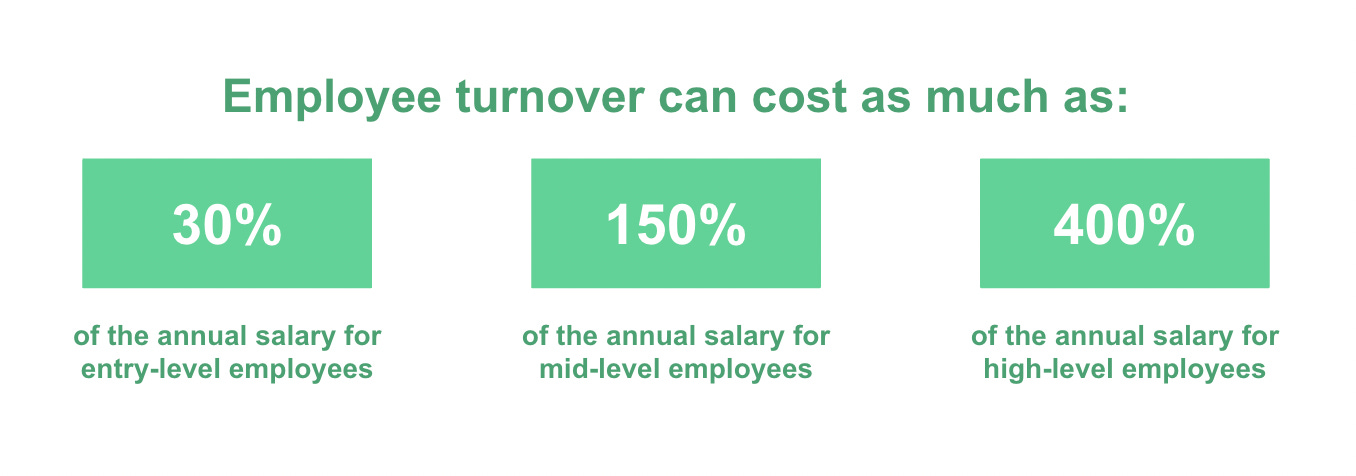
Source: Forces
Most companies just take these costs to the face as the cost of doing business.
Luckily there’s a way to decrease these costs by marginally increasing the amount you spend on training. It is essential for companies to continuously upskill and reskill their employees to stay competitive, retain top talent, and continue to build innovative products and services that will meet the evolving needs of their customers.
This need is one of the reasons that companies like Guild, Multiverse, Reforge, etc., have found incredible product-market fit over the past few years.
Let’s face it.
Most companies don’t do the best job training their employees. Here’s the reason for that: Teaching people something new is hard, expensive, and time-consuming.
It’s much easier for a company to hire smart people, give them a small training reimbursement, and hope they figure it out. But adoption for these tuition reimbursements usually hovers around 1% to 5%, and this is usually by design (to reduce costs, risk aversion, etc.).
And by leaving the employee to their own devices, companies almost guarantee failure. Completion rates for these programs is abysmal. People struggle to juggle work and upskilling. Companies typically have no clue how someone is progressing through a program until an employee submits a reimbursement form, and if it’s a multi-year program (like a degree), then they have 0 clue when that employee will finish or even how many credits they’ve completed. And then when an employee does complete a program, the company has no way to track or internalize that skill development. It was an absolute waste of spend for the company, and instead of trying to figure out how to make it better, they decide they’ll just continue trying to limit spend / adoption.
Genuinely curious—how many of our readers know a) what your company’s education benefits are, and b) have actually used them?
As a result, employees1 join companies and immediately feel unprepared, leading to imposter syndrome, lost productivity, and sometimes even resentment. This is all because the company hasn’t taken the proper effort to train them. Most eventually figure out how to effectively do the job but they are well aware that their employer didn’t contribute much to their development.
It’s surprising that businesses that usually pride themselves on precision and guaranteed returns would gamble on their most critical resources. Companies need to invest in their people—and I’m not just talking snack bars, stock options, and weekly happy hours. And this is no diss to snack bars (keep that Nutella in stock, WeWork!). All of these perks contribute to employee satisfaction and productivity, but they do nothing for skills-acquisition.
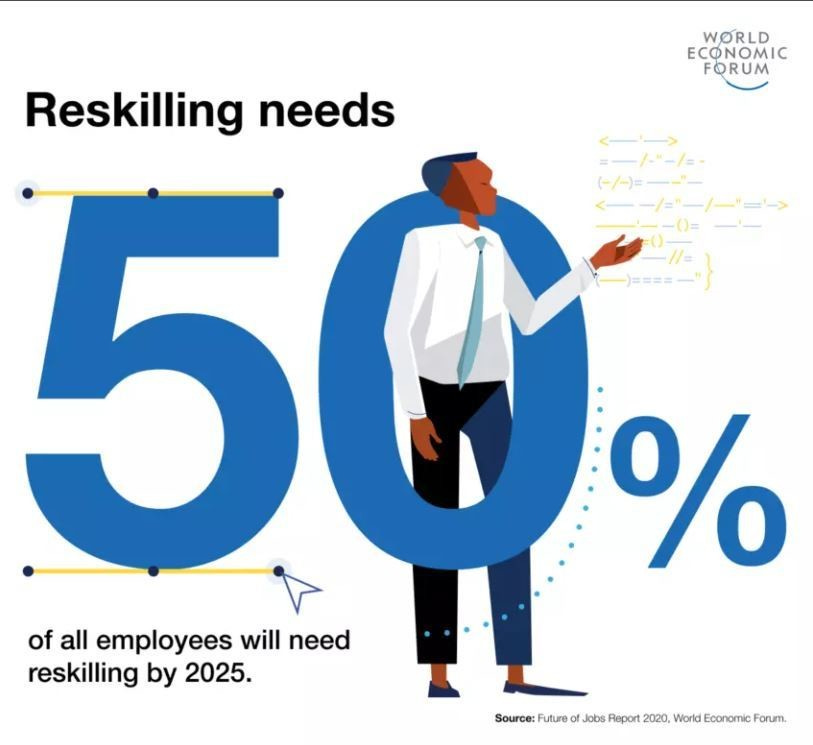
The World Economic Forum projects that 50% of employees need to reskill by 2025—and this estimate came before ChatGPT 3 made everyone feel the fear of obsolescence. Workers are now much more cognizant of the importance of acquiring new skills.
“Opportunities to learn and grow has emerged as the strongest driver of work culture. It shot up eight positions to become the top driver of great work culture by the end of 2020 (Glint: Employee Well-Being Report).”
By upskilling and reskilling employees, you provide them with additional training and development opportunities to enhance their current skill set and adapt to new technologies, processes, and job requirements. And as most Guild employers are finding, you also lock them into probably the best employee retention mechanism to-date. The quit rate for someone enrolled in a program (let alone a degree or apprenticeship) is extremely low.
Reskill, Refuel, Recharge
Investing in employee training and development programs not only benefits employees but also positively impacts the business's overall success. Upskilled employees bring new ideas and perspectives to the workplace, leading to increased innovation and productivity. They also feel more engaged and motivated in their jobs, leading to higher employee retention rates and reduced turnover.
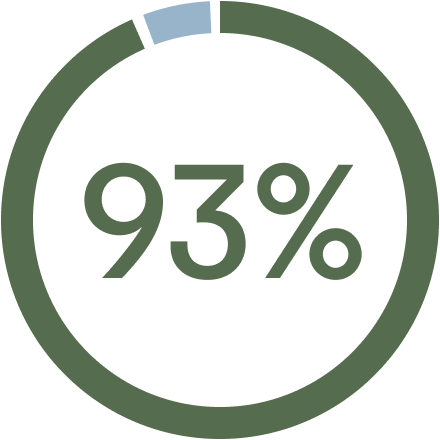
93% of companies are concerned about retention (LinkedIn). Upskilling and reskilling remains the #1 tool that companies have to retain their employees.
In addition, upskilling and reskilling employees help to bridge skills gaps within the company, reducing the need for costly external hires.
“Program participants have a 40% higher retention rate, and ~90% are more likely to receive a promotion.” - Guild
And skill pathways are predictable. For companies that are so obsessed with long range planning, you’d think they would treat human capital like capital. We have XX jobs that require YY skills, and we have a pipeline to deliver ZZ / year.
It’s currently taking 50% longer for companies to hire tech employees compared to other types of hires (66 days vs. 43 days, respectively), even in spite of the mass layoffs rattling tech. For developers specifically, the hiring timeline jumps to 81 days2. It also ensures that the company has a highly skilled workforce capable of adapting to future changes in the industry and staying ahead of the competition. Employee training and development programs are a win-win situation for both employees and businesses. It empowers employees to reach their full potential and provides businesses with a highly skilled and motivated workforce, leading to increased competitiveness and success in the long term.
What’s a company to do?
The tactical next steps for any enterprise are to assess their skill gaps. This is really hard to do. Theoretically, an Applicant Tracking System would connect to your HRIS and let you know what skills are coming in, what skills you have, and what’s missing. But that’s not the case. HR stacks are disconnected, and companies have pretty opaque understandings of what talent exists within their system. They defer to department leaders to tell them what skills are missing, but those departments are often siloed. Someone about to be furloughed in one department might hit all the requirements for a job in a completely different department.
So the easiest way to assess your skill gap is simply to see what jobs you’re posting for, what the durable and perishable skill requirements are (a better term for soft/hard skills), how many roles you’re posting for, and how long they’ve been open. High volume/long time-to-fill implies a high-demand job. You can either keep praying that you can find someone to fill it, and often have to entice applicants through additional RSUs and bonuses, etc. Or you can dedicate time to building skill pathways to those roles.
We’re partial to building those skill pathways, either through apprenticeships (Multiverse) or 3rd party training (Guild). As mentioned earlier, you get a predictable and controllable pipeline of candidates. These employees already have institutional knowledge about your company, they’ve already displayed a growth mindset, they retain at higher rates, and they need less time to ramp-on after they acquire skills.
The problem is that too many companies still see these investments as cost centers. The biggest barrier remains budget, because upskilling usually lives squarely with your HR department. Finding budget and commitment across stakeholders and departments is key. Because it impacts every department, and it contributes to your company culture and the story your company tells itself and the world.
From the Author, Michael Oppong Chris Blackett
We appreciate all of you! Our subscriber count is growing, and we’re almost at 100 in less than 2 weeks! If you like our content, please share it with friends or leave comments letting us know what you think, what we can do better, what you’d want to learn more about. We are learning, iterating, and trying to build a community slowly. Your support and engagement means so, so much to us.
"Glint. (2021, May). Employee Well-Being Report. LinkedIn Learning Solutions. Retrieved February 5, 2023, from https://business.linkedin.com/content/dam/me/business/en-us/amp/learning-solutions/images/lls-glint-microsite/content/Glint-May-2021-Employee-Well-Being-Report.pdf."
"Glint. (2021, May). Employee Well-Being Report. LinkedIn Learning Solutions. Retrieved February 5, 2023, from https://business.linkedin.com/content/dam/me/business/en-us/amp/learning-solutions/images/lls-glint-microsite/content/Glint-May-2021-Employee-Well-Being-Report.pdf."
 | A guest post by
|
 | A guest post by
|